Discover how ERMIFAM connects businesses with green technology solutions for renewable energy, water management, sustainable agriculture, and environmental projects.
The ERMIFAM Solution Provider Approach to Sustainable Projects
Introduction
Businesses around the world are facing increasing pressure to manage energy consumption, improve water efficiency, reduce environmental impacts, and adopt more sustainable operating practices. At the same time, organizations must control costs, maintain operational reliability, and ensure that investments deliver measurable commercial value.
Green technologies offer practical ways to address these challenges. Solar energy systems, water treatment technologies, wastewater recycling, efficient irrigation, sustainable agricultural inputs, and environmentally responsible building materials can help organizations improve resource management.
However, choosing the right technology is not always straightforward. The market includes numerous suppliers, different technical specifications, varying investment requirements, and products with different levels of commercial maturity. A technology that performs well in one application may not be suitable for another.
This is where a Solution Provider can make a difference.
ERMIFAM follows a solution-oriented business approach that connects customer requirements with suitable technologies, qualified suppliers, technical expertise, and potential implementation partners. Instead of focusing exclusively on selling individual products, the objective is to identify the most appropriate solution for a specific environmental or operational challenge.
This article explains how businesses can evaluate green technologies, select suitable solutions, assess investment opportunities, and develop projects through a structured Solution Provider approach.
1. What Is a Green Technology Solution Provider?
A green technology Solution Provider helps organizations identify, evaluate, source, and coordinate technologies that address environmental, energy, water, or resource-efficiency challenges.
Unlike a conventional product seller, a Solution Provider begins with the customer’s problem rather than a predetermined product.
For example, a hotel experiencing high electricity costs may need more than solar panels. It may require an assessment of its electricity consumption, rooftop capacity, energy storage requirements, equipment efficiency, financing options, and installation partners.
Similarly, a commercial farm facing water shortages may need a combination of water treatment, efficient irrigation, soil management, and agricultural inputs rather than a single piece of equipment.
A Solution Provider helps bring these elements together into a practical project concept.
Depending on the project, its role may include:
- Identifying the customer’s environmental or operational challenge.
- Evaluating suitable technologies and alternative solutions.
- Researching and screening manufacturers and suppliers.
- Comparing technical specifications, costs, and expected performance.
- Coordinating with engineering firms, consultants, and implementation partners.
- Supporting commercial negotiations and international sourcing.
- Helping identify potential financing and investment partners.
- Facilitating project development and follow-up through agreed responsibilities.
The exact scope depends on the project’s complexity and the agreements between the customer, suppliers, and other stakeholders.
2. Why Businesses Need a Solution-Oriented Approach
Selecting technology based only on its purchase price can lead to expensive mistakes. A lower-priced system may have higher operating costs, limited technical support, unsuitable capacity, or poor compatibility with existing infrastructure.
A solution-oriented approach considers the complete operating environment.
Understanding the actual problem
Before selecting equipment, businesses should establish what they need to improve.
A factory may want to reduce electricity expenses, while a hotel may be concerned about water availability. An agricultural business may need to improve irrigation efficiency or address specific nutrient deficiencies.
Each problem requires a different assessment.
Comparing alternatives
Several technologies may address the same challenge. For example, a water-supply project might consider conventional water treatment, reverse osmosis, rainwater harvesting, water reuse, or atmospheric water generation.
The appropriate option depends on water quality, required output, climate, energy availability, regulations, operating costs, and the intended use of the water.
Evaluating total cost
The purchase price represents only one part of a project’s financial requirements.
A realistic evaluation should consider installation, energy consumption, maintenance, replacement components, transportation, training, regulatory compliance, and expected equipment life.
Coordinating the right partners
Many projects require more than one supplier. Solar installations may need equipment manufacturers, engineering contractors, installers, financing partners, and maintenance providers.
A Solution Provider can help coordinate these relationships and clarify the responsibilities of each participant.
3. Key Green Technology Solutions for Commercial Projects
ERMIFAM’s solution-oriented approach can cover several environmental technology categories, depending on customer demand, supplier qualification, technical feasibility, and project economics.
Solar energy and energy efficiency
Solar photovoltaic systems can help commercial and industrial facilities generate electricity from renewable sources.
Potential applications include hotels, office buildings, warehouses, agricultural facilities, and industrial sites.
A project assessment should examine electricity consumption patterns, available installation space, grid connection conditions, equipment compatibility, installation costs, and maintenance requirements.
Battery storage may be appropriate where backup power or a different consumption profile justifies the additional investment. However, storage should not automatically be included in every solar project.
Energy efficiency measures should also be evaluated because reducing unnecessary electricity consumption can improve the economics of a renewable energy investment.
Water treatment and purification
Water availability and quality are important concerns for residential developments, hospitality businesses, agricultural operations, and industrial facilities.
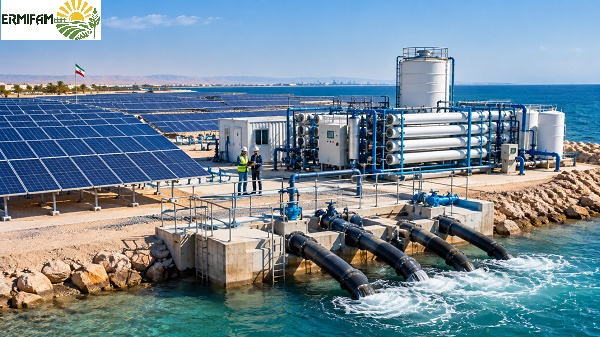
Potential solutions include filtration, membrane treatment, reverse osmosis, brackish-water treatment, and other purification technologies.
The correct system depends on the source water, laboratory analysis, required water quality, daily demand, energy availability, and wastewater-management requirements.
A properly designed project should consider pretreatment, consumables, maintenance, reject-water management, and the applicable drinking-water or industrial-water standards.
Wastewater treatment and water reuse
Wastewater treatment can help businesses manage environmental obligations and potentially recover water for suitable applications.
Depending on the wastewater characteristics and local regulations, treated water may be suitable for certain irrigation, cleaning, cooling, or industrial processes.
A feasibility assessment should examine wastewater composition, treatment targets, infrastructure requirements, operating costs, and the permitted uses of the treated water.
Water reuse should never be assumed suitable for every application without appropriate treatment and verification.
Sustainable agriculture and irrigation
Agricultural businesses can consider technologies that support more efficient water use and improved nutrient management.
Examples include drip irrigation, fertigation equipment, soil-moisture monitoring, water treatment for irrigation, and selected organic or specialty fertilizers.
The best combination depends on crop type, soil conditions, climate, irrigation-water quality, and farm economics.
Fertilizer recommendations should be based on agronomic requirements and reliable product information rather than broad claims about technology.
Environmentally responsible building materials
Buildings and infrastructure projects may benefit from materials and coatings designed to improve energy efficiency, durability, or resource management.
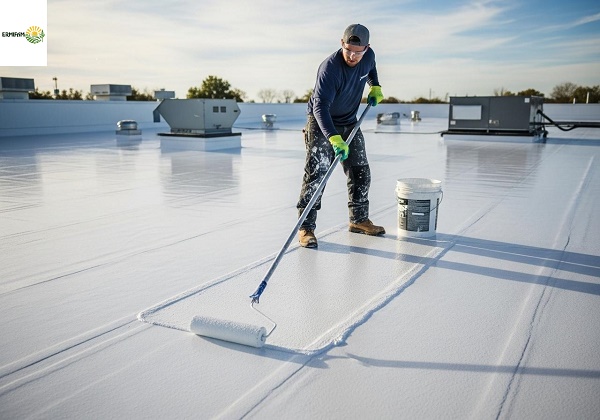
Examples include selected solar-reflective coatings, thermal-insulation systems, and materials developed for specific environmental performance requirements.
Before recommending a product, the Solution Provider should review its technical documentation, suitability for the building, expected service life, installation requirements, and independently supported performance claims.
4. The ERMIFAM Solution Provider Model
ERMIFAM aims to connect environmental challenges with appropriate technologies and commercial opportunities through a structured B2B approach.
The model focuses on project suitability, supplier evaluation, international sourcing, and collaboration with relevant technical and commercial partners.
Step 1: Identify the customer’s needs
The process begins with a discussion of the customer’s objectives, operating conditions, budget expectations, and main challenges.
For example, a hotel may want to reduce electricity costs and improve energy resilience. A farm may need a reliable irrigation-water supply. An industrial customer may be seeking a solution for wastewater management.
The initial objective is to define the problem clearly enough to evaluate realistic options.
Step 2: Define the technical requirements
Once the challenge is understood, the required performance and operating conditions must be established.
For a solar project, these may include electricity demand, available space, grid conditions, and backup requirements.
For a water-treatment project, they may include source-water analysis, required water output, water quality, and disposal arrangements.
Clear requirements make supplier comparisons more meaningful and reduce the risk of selecting unsuitable equipment.
Step 3: Identify and screen suppliers
ERMIFAM can research manufacturers, technology developers, and specialized suppliers in relevant markets.
Supplier screening should consider technical capability, product documentation, manufacturing consistency, commercial terms, export experience, warranty arrangements, spare-parts availability, and after-sales support.
Supplier claims should be checked wherever possible. Product catalogues alone are not sufficient evidence of successful project performance.
Step 4: Compare available solutions
Potential options can be evaluated through a structured comparison of technical suitability, initial investment, operating expenses, expected benefits, implementation complexity, and regulatory requirements.
Where necessary, an independent engineering assessment or specialist consultation should be obtained.
The objective is not to promote the most expensive or newest technology. It is to identify the option that best matches the customer’s needs and constraints.
Step 5: Develop the commercial proposal
After a preferred approach has been identified, the project team can prepare a commercial proposal covering the proposed scope, equipment or services, estimated costs, supplier responsibilities, delivery arrangements, and implementation requirements.
Where reliable data are available, the proposal may also include estimated savings, operating costs, and financial scenarios.
All assumptions should be stated clearly. Financial projections must not be presented as guaranteed results.
Step 6: Coordinate implementation partners
Depending on the agreement, implementation may involve manufacturers, engineering consultants, installers, contractors, financing institutions, or local distributors.
Each party should have clearly defined responsibilities, including technical approvals, permits, installation, testing, commissioning, training, and maintenance.
ERMIFAM’s specific responsibilities should be established in the project contract and should reflect its actual technical capacity and commercial role.
Step 7: Review results and identify improvements
Where the project scope permits, performance can be reviewed against agreed indicators.
These may include electricity generated, water treated, water reused, operating expenditure, maintenance frequency, or resource consumption per unit of production.
Monitoring provides a basis for identifying operational problems and evaluating whether the project is delivering its intended benefits.
5. How to Evaluate the Financial Feasibility of a Green Project
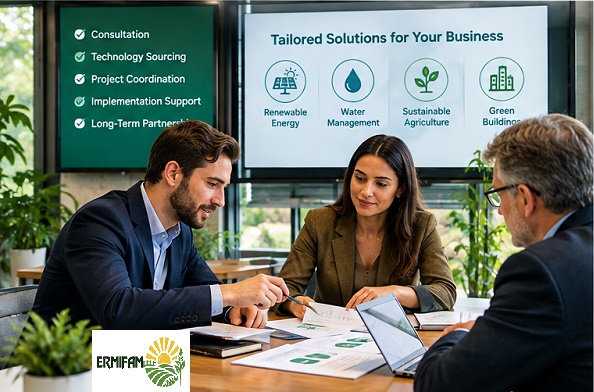
Environmental benefits are important, but commercial projects must also be financially realistic.
A preliminary feasibility study should distinguish between capital expenditure, operating expenditure, expected financial benefits, and project risks.
Initial investment
Capital expenditure may include equipment, transportation, installation, engineering, electrical or civil works, testing, permits, and other project-specific costs.
International projects may also require currency conversion, import duties, insurance, and additional logistics expenses.
Operating expenditure
Operating costs can include electricity, water, consumables, maintenance, replacement parts, personnel, and service contracts.
These expenses can have a substantial influence on the long-term value of a technology.
Expected financial benefits
Potential benefits depend on the application. They may include lower electricity purchases, reduced water procurement costs, improved resource efficiency, or lower expenditure on waste management.
Benefits should be estimated using actual operating data wherever possible.
Payback period
A simple preliminary payback calculation is:
Payback period = Initial investment ÷ Annual net cash savings
This calculation is only a screening tool. It does not account for all factors, such as financing costs, taxes, equipment replacement, changes in energy prices, or the time value of money.
More complex projects may require discounted cash-flow analysis, net present value, and sensitivity analysis.
Risk assessment
A feasibility study should also evaluate supplier reliability, technical performance, regulatory approval, foreign-exchange exposure, construction delays, and customer demand.
A project should proceed only when its key assumptions have been examined and its risks are understood.
6. Financing and Partnership Opportunities
Some green technology projects require significant initial investment, even when they may reduce operating costs over time.
Depending on the project and country, potential financing arrangements may include customer-funded investment, commercial lending, equipment financing, leasing, investment partnerships, or eligible public-sector programs.
The availability of these options depends on local laws, lender requirements, customer creditworthiness, project documentation, and the commercial structure.
A Solution Provider can help identify relevant financing possibilities and coordinate discussions with qualified financial partners. It should not promise loan approval or investment returns.
Partnerships may also bring together equipment suppliers, project developers, engineering firms, building developers, agricultural companies, and financial institutions.
Clear agreements are important to establish how project development costs, responsibilities, risks, and commercial revenues will be allocated.
7. Green Technology Projects for Different Customer Segments
A B2B Solution Provider can serve different customer groups by tailoring its recommendations to their operating requirements.
Hotels and hospitality businesses: Potential projects include solar energy, energy efficiency, water purification, wastewater treatment, and selected water-saving technologies.
Commercial and residential developments: Potential solutions include shared solar systems, efficient water infrastructure, appropriate water-reuse systems, and environmentally responsible building materials.
Agricultural businesses: Projects may involve irrigation efficiency, water treatment, fertigation, soil management, and suitable agricultural inputs.
Industrial companies: Relevant applications may include industrial wastewater treatment, water recycling, renewable energy integration, and resource-efficiency improvements.
Remote and infrastructure projects: Depending on site conditions, opportunities may include modular water-treatment systems, distributed solar power, and other technologies designed for locations with limited infrastructure.
Each segment requires a different sales approach, technical assessment, and investment model. A standardized catalogue may help introduce available technologies, but the final recommendation should be tailored to the actual project.
8. International Sourcing and Export Development
International sourcing can give customers access to a wider range of technologies, but it also introduces additional commercial and regulatory considerations.
A Solution Provider should compare suppliers across relevant markets without assuming that a product from a particular country is automatically superior.
The assessment should cover product specifications, certification, manufacturing capability, delivery time, warranty terms, technical support, and the total landed cost.
For export-oriented projects, the analysis should also consider destination-market demand, local registration requirements, import procedures, distribution partners, and the customer’s ability to service the technology after installation.
Potential regional opportunities should be validated individually. Geographic proximity alone does not establish market demand or commercial viability.
Where equipment is imported, the parties should clarify customs responsibilities, delivery terms, documentation, payment arrangements, and responsibility for technical compliance.
Where locally manufactured technologies are commercially competitive, ERMIFAM may also explore opportunities to connect domestic suppliers with international B2B buyers.
This approach supports a flexible business model based on finding suitable solutions rather than limiting the company to one manufacturer or product category.
9. Common Mistakes to Avoid When Selecting Green Technologies
Businesses can reduce project risk by avoiding several common mistakes.
Choosing technology before defining the problem: A supplier’s product should not determine the project requirements. Start with the customer’s needs and operating conditions.
Relying on unsupported performance claims: Verify technical specifications and request suitable independent test results or project references.
Ignoring maintenance and spare parts: A system that cannot be maintained locally may become unreliable or expensive to operate.
Underestimating implementation costs: Include installation, permits, infrastructure modifications, training, and logistics in the financial assessment.
Overlooking regulatory requirements: Check the applicable environmental, electrical, water-quality, building, and product-registration rules before procurement.
Assuming every green project is profitable: Environmental value and financial returns are separate questions. Both should be assessed.
Failing to define responsibilities: Establish clear contractual obligations for design, supply, installation, testing, warranties, and ongoing support.
Avoiding these mistakes helps customers make better-informed decisions and improves the prospects for successful project delivery.
10. Why a Solution Provider Can Create Long-Term Value
The value of a Solution Provider comes from connecting separate elements that customers might otherwise have to coordinate independently.
These elements include customer requirements, technical expertise, suitable technologies, reliable suppliers, project partners, commercial agreements, and implementation planning.
For customers, this approach can make the evaluation process more structured and help them compare alternatives using consistent criteria.
For technology manufacturers, it can create access to new B2B customers and international business opportunities.
For project developers and investors, it can help identify potential projects that require technical solutions, supplier coordination, and commercial development.
For ERMIFAM, this creates opportunities to build a business around environmental technology sourcing, solution development, international trade, and project partnerships without relying exclusively on manufacturing or retail sales.
The model must nevertheless be supported by reliable information, transparent commercial terms, appropriate technical expertise, and realistic commitments.
Conclusion
Choosing the right green technology requires more than identifying an environmentally friendly product. Businesses need to understand their operational challenges, evaluate technical alternatives, calculate total costs, assess risks, and work with qualified suppliers and implementation partners.
A Solution Provider brings these elements together through a structured, customer-focused process.
ERMIFAM’s approach is to connect environmental needs with relevant technologies and commercial opportunities across areas such as renewable energy, water management, sustainable agriculture, and resource efficiency.
By prioritizing technical suitability, supplier verification, financial feasibility, and long-term operational value, ERMIFAM aims to support organizations in developing practical and commercially grounded environmental projects.
ERMIFAM — Connecting Environmental Challenges with Practical Green Technology Solutions.
Frequently Asked Questions
What does a green technology Solution Provider do?
A green technology Solution Provider helps customers identify environmental challenges, evaluate suitable technologies, source qualified suppliers, and coordinate commercial or technical partners for project development.
How is a Solution Provider different from an equipment supplier?
An equipment supplier primarily sells products. A Solution Provider begins with the customer’s requirements and may coordinate several technologies, suppliers, and services to address a broader operational problem.
Which industries can benefit from green technology solutions?
Hotels, commercial buildings, agriculture, manufacturing, infrastructure, and other sectors can benefit from suitable solutions for energy efficiency, renewable energy, water management, and resource optimization.
Does ERMIFAM manufacture all the technologies it offers?
The Solution Provider model does not require every technology to be manufactured in-house. Depending on the project, suitable solutions can be sourced from qualified manufacturers and delivered through appropriate technical and commercial partnerships.
How can a business determine whether a green technology project is financially viable?
The business should evaluate capital expenditure, operating costs, expected savings, financing requirements, regulatory obligations, technical risks, and potential payback. More complex projects may require a detailed feasibility study.
Can ERMIFAM help with international sourcing?
ERMIFAM’s solution-oriented approach can include researching manufacturers, comparing technical and commercial offers, and identifying potential B2B partners. The actual scope depends on the project and the agreed services.
Are green technology investments always profitable?
No. Financial results depend on technology performance, installation costs, operating conditions, energy and water prices, financing, maintenance, and other factors. Each project should be assessed individually.
How can a company start working with ERMIFAM?
A company can begin by describing its main environmental or operational challenge, its location, approximate project requirements, and its objectives. This information can provide a starting point for identifying potential solutions and the next steps for technical and commercial evaluation.