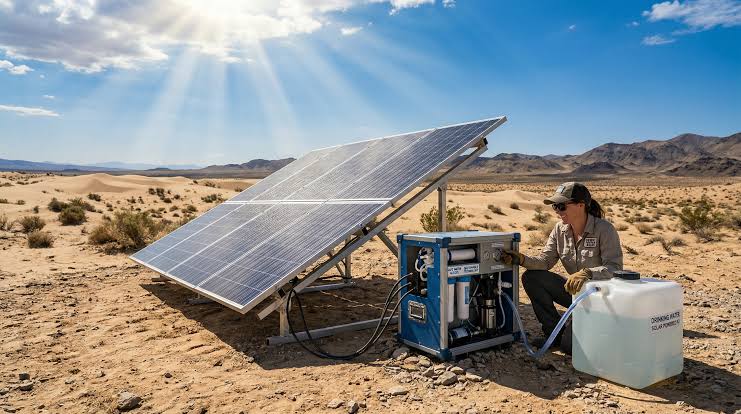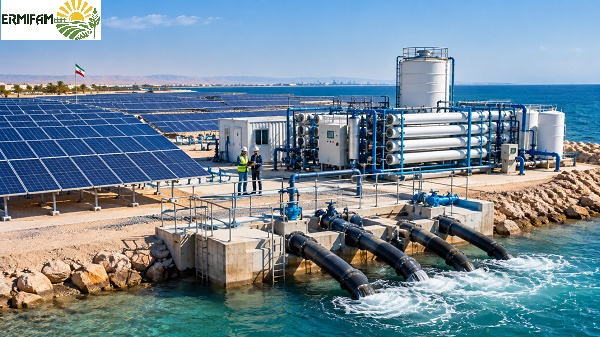
Solar powered water purification are needed for new era. The convergence of Iran’s severe water crisis and its abundant solar energy resources has positioned solar powered water purification as a critical technological solution. The following analysis examines the scope of the crisis and evaluates the technical, economic, and practical dimensions of deploying solar purification systems across the country.
Iran’s Water Crisis: A Five-Year Drought with No End in Sight
Iran is facing its fifth consecutive year of drought in 2025, with conditions described as the worst in more than six decades. The country’s average annual rainfall has dropped to 45 percent below normal, and nineteen of its thirty-one provinces are in a state of severe drought. The reservoirs supplying the capital Tehran have been critically depleted: the Latian Dam is currently holding less than 10% of its capacity, and some reservoirs are operating at only 5 percent of reserve capacity.
The human-induced climate change component is significant. A rapid attribution study found strong evidence that anthropogenic climate change has increased the risk of drought in the region by more than a factor of ten, rolling back decades of development gains. However, the crisis is compounded by socio-economic factors, including population growth, rising demand, resource exploitation, and uneven distribution. Government mismanagement and corruption have also played a role, with dam-building companies prioritizing political power and profit-seeking over water preservation.
Solar Powered Desalination: The Technical Landscape
Iran’s geographical position offers a significant advantage for solar-powered water purification: the country possesses some of the highest solar irradiation levels in the world, particularly in its southern and central regions. This natural endowment makes solar-driven desalination a technically viable and economically attractive pathway for addressing water scarcity.
Several solar desalination technologies have been developed and tested within Iran, spanning small-scale passive systems to large-scale reverse osmosis (RO) plants.
Passive Solar Still Systems
Passive solar still systems represent the simplest and lowest-cost approach to solar desalination. A recent study conducted in Tehran evaluated a passive, solar-powered desalination system integrating a solar water heater, a thermally insulated evaporation chamber, and a spiral condenser coil linked to a water-based cooling tower. Field tests during August and September 2023 demonstrated a substantial increase in daily water output following the integration of the cooling tower—from 3,018 to 6,978 mL in August and from 2,409 to 7,016 mL in September, representing gains of 286.82 and 231.21 percent respectively.
The system also sustained overnight water production due to effective thermal insulation, yielding approximately 1,936 mL of distilled water after sunset. Water quality analysis confirmed the removal of toxic elements while retaining essential minerals within safe limits. The economic analysis indicated a cost of $0.526 per liter in the first year, decreasing to $0.105 per liter over five years, with an internal rate of return of 26.50 percent. The system’s embodied carbon footprint was estimated at 0.139 kg CO₂ per liter of water produced, with zero operational emissions.
Reverse Osmosis with Solar Photovoltaics
Reverse osmosis (RO) powered by solar photovoltaic (PV) systems represents a more scalable approach, particularly for coastal regions. A feasibility study for Chabahar, a water-scarce coastal city in southeastern Iran, evaluated solar-driven RO desalination using HOMER software. The results showed that an on-grid scenario with a 12-hour power supply was the most economical option, with a cost of electricity generation of $0.045 per kWh. This optimal system includes a 120-kW PV array and a 75-kW converter, with solar power generation of 206,656 kWh per year, preventing approximately 65 tons of CO₂ emissions annually.
For off-grid scenarios, the most economical option achieved a cost of $0.227 per kWh, comprising a 120-kW PV system, a 10-kW generator, 75 batteries, and a 25-kW converter. The study highlighted the importance of Iran’s incentivized solar electricity purchase tariff in making these systems economically viable.
A separate techno-economic study examined a large-scale desalination plant in Bushehr province, comparing grid-only, grid-PV configurations, and off-grid scenarios. The results showed that PV directly supplied up to 41.5% of the seawater reverse osmosis load. While the levelized cost of water rose from $0.60/m³ in the grid-only scenario to $6.68/m³ in the fully off-grid scenario, the cumulative energy demand and exergy demand decreased by nearly 55% in the off-grid configuration.
Greywater Purification with Membrane Distillation
Beyond seawater desalination, solar-powered systems can also address water scarcity through greywater recycling. A study from Tehran presented an innovative solar-powered greywater purification system integrating direct contact membrane distillation (DCMD) technology with solar thermal collectors for residential buildings. The system, operating with a feed temperature of 60°C, achieved a permeate flux of 80.65 kg/m²·h, meeting 53.3% of residents’ domestic hot water demand.
The economic analysis revealed promising results: the solar collectors provided heat at a levelized cost of $0.017 per kWh, and the DCMD system purified water at $2.38 per m³. The environmental impact assessment showed significant carbon dioxide reduction, preventing 70,185 kg of CO₂ emissions annually, with a remarkably short payback period of three years when considering both carbon tax savings and avoided natural gas costs. Since greywater comprises nearly 75% of total wastewater, this approach presents a promising solution for arid regions.
Economic and Environmental Dimensions
The economic viability of solar-powered water purification in Iran depends on several factors, including the scale of deployment, the specific technology employed, and the availability of grid backup or energy storage.
Cost Competitiveness
For small-scale passive solar stills, the cost per liter of freshwater production decreased from $0.037 to $0.016 with the incorporation of active materials, solar tracking, and mirror reflectors, confirming the economic viability of optimized systems. The daily yield improved from 902.2 to 1,426 mL/m²·day using machine learning-based optimization with an LSTM model achieving an R² of 0.96.
For medium-scale RO systems, the on-grid scenario in Chabahar achieved a competitive cost of electricity generation at $0.045 per kWh, making it the most economical option for that location. However, off-grid configurations with battery storage increased costs significantly to $0.227 per kWh.
At the large-scale, the Bushehr study demonstrated that while the levelized cost of water rose to $6.68/m³ in fully off-grid scenarios, the environmental and resource-demand benefits were substantial, with cumulative energy demand and exergy demand decreasing by nearly 55%.
Environmental Impact
Solar-powered desalination systems offer significant environmental advantages over fossil fuel-powered alternatives. The Bushehr study showed that as the share of PV increased, environmental burdens shifted toward eutrophication, toxicity, land use, mineral resource scarcity, and water resource scarcity, while cumulative energy demand and exergy demand decreased substantially.
A wind-powered RO desalination plant with hydrogen storage, also designed for Chabahar, demonstrated that renewable energy integration could reduce annual CO₂ emissions to just 358 tons, an 80.4% reduction compared to a fully diesel-powered alternative. The system was designed to produce 3,500 m³/day of freshwater with a levelized cost of water of $0.945/m³.
For residential greywater purification, the solar-powered DCMD system prevented 70,185 kg of CO₂ emissions annually, with zero operational emissions from the purification process itself.
Implementation Challenges and Barriers
Despite the technical and economic promise of solar-powered water purification, several barriers impede widespread deployment in Iran.
Economic and Institutional Constraints
Iran’s fossil fuel-dependent economy presents a paradox: while the country possesses exceptional solar resources, subsidized energy tariffs and high inflation can obscure the economic justification for renewable energy adoption. The levelized cost of energy for renewable scenarios was found to be sensitive to Iran’s economic conditions, making investment decisions challenging.
Furthermore, the study noted that renewable integration shifted environmental burdens toward toxicity, resource scarcity, and land use, indicating that a comprehensive life-cycle perspective is necessary when evaluating these systems.
Technical and Operational Considerations
For off-grid systems, energy storage remains a significant cost driver. The Chabahar study found that off-grid configurations required 75 batteries and a 25-kW converter for a 120-kW PV system, substantially increasing capital costs. However, ongoing advances in battery technology and the potential for hybrid wind-solar systems with hydrogen storage may help address this challenge.
For passive solar still systems, the primary limitation is the relatively low productivity per unit area. The optimized system in Tehran achieved a daily yield of 1,426 mL/m²·day, which, while an improvement over conventional systems, still requires substantial land area for meaningful water production.
Policy and Governance
The root causes of Iran’s water crisis extend beyond technical solutions. Government mismanagement, corruption, and the prioritization of political power over water preservation have contributed significantly to the crisis. Without addressing these governance issues, even the most advanced solar purification technologies may fall short of their potential impact.
Recent Innovations and Pilot Projects
- Solar-Powered Water Purification: Iran’s Drought Solution
Iran has recently demonstrated growing capacity for self-reliant technological innovation in this sector. In June 2026, Iranian engineers unveiled a fully independent mobile water purification system that requires no grid electricity or centralized water source. The system features a water purification module alongside an off-grid solar system (photovoltaic panels, inverter, and battery storage) that operates up to 10 hours daily, even after sunset. It uses nanocarbon membranes capable of lasting up to 15 years without filter replacement. Water is sourced locally from rainwater tanks, irrigation canals, or wells, and then purified into safe drinking water. The project won Iran’s National Social Innovation Competition and is being expanded with higher-capacity versions for testing in remote areas.
In the agricultural sector, Iran has launched several solar-powered water initiatives. In Sistan and Baluchestan province, 60 livestock wells have been rehabilitated and fitted with modern solar pumping systems, benefiting 480 nomadic families directly. The solar-powered systems eliminate dependence on costly fossil fuels, enabling nomads to secure livestock water efficiently. Nationwide, 110 pilot smart irrigation projects covering approximately 10,000 hectares are underway, with plans to equip 10,000 diesel-powered wells with solar panels.
Additionally, Yazd province has implemented an innovative agri-voltaic project combining solar energy generation with pistachio cultivation. The project involves installing solar panels at an optimal height above pistachio trees, serving a dual purpose of energy generation and water conservation.
Conclusion
Solar-powered water purification systems present a technically viable, economically increasingly competitive, and environmentally sustainable response to Iran’s drought crisis. The country’s exceptional solar irradiation, combined with a range of available technologies—from low-cost passive solar stills to large-scale PV-powered reverse osmosis and innovative greywater recycling systems—offers a diversified portfolio of solutions tailored to different contexts and scales.
The economic case for solar desalination is strengthening, with on-grid PV-RO systems achieving competitive electricity costs and small-scale passive systems demonstrating short payback periods. Environmental benefits are substantial, with significant reductions in CO₂ emissions and cumulative energy demand compared to fossil fuel-powered alternatives.
However, realizing the full potential of these technologies requires addressing governance challenges, reforming energy subsidies, and investing in the research, development, and deployment of context-appropriate systems. The recent innovations emerging from Iranian universities and research centers—including the mobile solar purification unit and the greywater DCMD system—demonstrate the country’s growing capacity for self-reliant technological development. If these innovations can be scaled and deployed effectively, solar-powered water purification could indeed constitute a “green revolution” in Iran’s water supply, offering a sustainable pathway out of its drought crisis.

Solar

Water