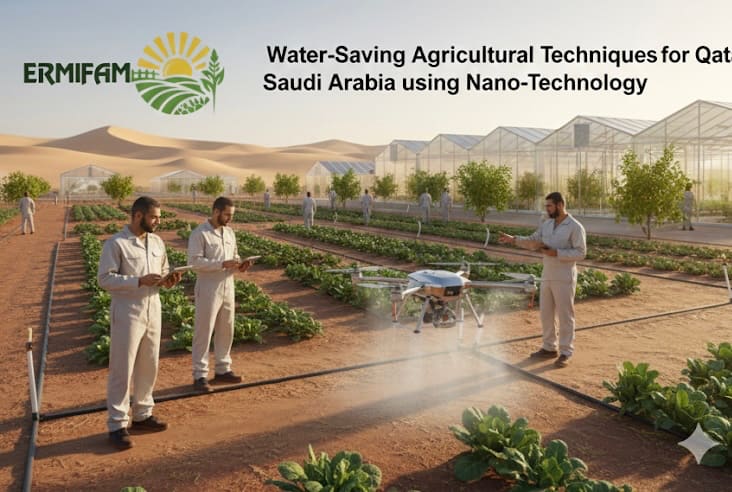
How Qatar cut agricultural water use by 40% using nano-technology farming. Real data, case studies, and lessons for desert nations.
Summary
How Qatar cut agricultural water use by 40% using nano-technology farming. Real data, case studies, and lessons for desert nations.
Qatar reduced agricultural water consumption by 40% by adopting nano-technology farming solutions such as nano-sensors, smart irrigation, nano-fertilizers, and energy-efficient desalination. These innovations improved crop yields, cut energy use by 29%, reduced chemical runoff, and supported Qatar’s Vision 2030 sustainability goals. The model offers a scalable blueprint for water-scarce desert nations seeking food security without exhausting freshwater resources.
Introduction
Qatar has achieved what many thought impossible: reducing agricultural water consumption by 40% through innovative water-saving agricultural techniques using nano-technology. In a region where water scarcity threatens food security, this breakthrough represents a significant milestone for desert nations struggling with extreme aridity and limited freshwater resources.
Agriculture in Qatar and neighboring Saudi Arabia has traditionally faced enormous challenges due to the harsh desert climate. However, nano-technology applications are now transforming farming practices across these water-stressed countries. Specifically, the integration of nano-sensors, specialized coatings, and smart irrigation systems has enabled unprecedented water conservation while simultaneously improving crop yields.
This article explores how Qatar’s strategic implementation of nano-technology in agriculture is addressing critical water challenges. Additionally, we’ll examine the economic benefits of these innovations, the growing startup ecosystem supporting this revolution, and how these techniques are contributing to Qatar’s Vision 2030 sustainability goals. Indeed, these advancements may provide a blueprint for other arid regions facing similar water security challenges.
Water Scarcity in Qatar and the Need for Innovation
Water scarcity represents one of the most pressing challenges facing Qatar today. As an arid nation with extremely limited natural water resources, the country faces unique hurdles in maintaining water security while supporting its growing population and ambitious development goals.
Declining Groundwater and Rising Demand
Qatar’s groundwater reserves—the nation’s only natural freshwater resource—are rapidly diminishing. Currently, the extraction rate vastly exceeds the natural replenishment rate, with groundwater being withdrawn at approximately seven times its recharge rate [1]. This unsustainable practice has led to a dramatic reduction in freshwater availability across the country. In 1971, freshwater was available under 15% of Qatar’s land area; by 2009, this figure had plummeted to merely 2% [1].
The agricultural sector bears significant responsibility for this depletion, consuming approximately 91% of Qatar’s groundwater resources [1]. Furthermore, farming practices often employ inefficient irrigation methods that waste substantial amounts of water through evaporation in Qatar’s hot climate [1].
Meanwhile, domestic water consumption in Qatar has reached alarming levels. At approximately 500 liters per person per day, Qatar maintains one of the highest per capita water usage rates in the world—nearly three times the global average of 180 liters [2][3]. Given that Qatar’s population continues to grow rapidly, with domestic water consumption doubling between 2010 and 2020, the pressure on water resources intensifies each year [4].
Desalination Dependency and Energy Costs
In response to declining groundwater reserves, Qatar has become extraordinarily dependent on desalination. Currently, desalination provides 99% of Qatar’s municipal water needs [5][1]. Nevertheless, this solution comes with significant drawbacks.
First, desalination facilities are exceptionally energy-intensive. Fuel costs alone account for approximately 70% of total desalination expenses [1]. The environmental impact is equally concerning—desalination generates substantial amounts of brine (concentrated salt solution), with Qatar contributing about 5.8% to global brine production [5].
Moreover, Qatar’s water storage capacity presents a vulnerability. Until recently, the country maintained only a 48-hour emergency water supply [4]. To address this risk, Qatar’s state-owned water utility KAHRAMAA initiated the Mega Reservoirs Project in 2015, aiming to extend storage capacity to seven days by constructing 24 large concrete reservoirs [5].
Vision 2030 and Agricultural Sustainability Goals
Qatar’s National Food Security Strategy 2030 has established ambitious targets for agricultural self-sufficiency while recognizing the need for water conservation. Remarkably, local farms now produce nearly 100% of vegetables sold during peak growing seasons [6], demonstrating significant progress.
To support these goals while addressing water scarcity, Qatar is actively pursuing innovative Water-Saving Agricultural Techniques using Nano-Technology. The Qatar Environment and Energy Research Institute (QEERI) is developing advanced systems to help farms use resources more efficiently through:
- Sensor-based monitoring of temperature, humidity, and water quality
- Resource management tools that provide real-time insights and recommendations
- Farm Sustainability Index measuring water use, energy consumption, and food production [6]
Hydroponic systems, a key component of Qatar’s agricultural innovation strategy, offer extraordinary water efficiency—reducing consumption by 70-90% compared to conventional farming methods [6]. Consequently, these technologies enable Qatar to maintain food production despite severe water limitations.
The integration of renewable energy sources, particularly solar power, with water management technologies presents a promising path forward. Such partnerships between agricultural innovation and sustainable water management will be essential for Qatar to achieve its vision of food security in an extremely water-scarce environment.
How Nanotechnology Enables 40% Water Reduction in Farming
Nanotechnology applications in agriculture represent a quantum leap in water conservation techniques. Through precision monitoring, targeted delivery systems, and innovative materials, these microscopic solutions are creating macroscopic impacts on water usage across arid regions.
Nano-Sensors for Real-Time Soil Moisture Monitoring
Nanoscale sensors have fundamentally changed irrigation practices by providing unprecedented precision in soil monitoring. These tiny devices measure soil moisture, temperature, and nutrient levels with accuracy down to parts per billion, enabling detection of biochemical changes that would otherwise remain invisible [7]. Rather than relying on scheduled watering, farmers can now make irrigation decisions based on actual field conditions.
The practical applications of these sensors have yielded impressive results globally. In Spanish vineyards, nanosensor-guided irrigation systems have improved water use efficiency by 40% while enhancing grape quality [8]. Similarly, almond orchards in California implemented nanosensor networks that reduced water consumption by 25% during severe drought conditions [8]. Australian cotton farms recorded a 35% increase in water-use efficiency alongside a 15% boost in production after adopting precision nano-irrigation [8].
These systems work by creating real-time feedback loops. When sensors detect developing drought stress in crops, automated irrigation systems respond immediately, preventing yield loss [8]. This early intervention capability makes nano-sensors particularly valuable in water-stressed environments like Qatar, where every drop counts.
Slow-Release Nano-Fertilizers for Targeted Irrigation

Conventional fertilizer application often leads to significant water waste as farmers must irrigate extensively to distribute nutrients. Nano-fertilizers solve this problem through controlled-release mechanisms that fundamentally alter how crops receive nutrition.
The Sri Lankan Institute of Nanotechnology developed urea-coated hydroxyapatite nanoparticles that release nutrients 12 times more slowly than conventional fertilizers [9]. This dramatic slowdown allows plants to absorb nutrients efficiently over time, eliminating the need for water-intensive fertilizer distribution.
Field tests demonstrate that these nano-fertilizers improve nutrient absorption by up to 80% compared to conventional methods [7]. Essentially, the controlled release ensures plants receive precisely what they need, when they need it. In practical terms, this has enabled farmers to reduce fertilizer application by 30-50% while maintaining or improving yields [7].
Perhaps most remarkably, researchers have shown that rice crops produced significantly enhanced yields even when using 50% less urea-based fertilizer in nano form [9]. This “less is more” approach directly translates to water conservation, as less fertilizer means less irrigation water needed for application and reduced chemical runoff.
Nano-Coated Irrigation Pipes to Minimize Evaporation
In desert environments, evaporation represents a major source of water loss. Nano-coatings applied to irrigation infrastructure address this challenge at the molecular level. These specialized materials create barriers that significantly reduce water evaporation during transport and delivery.
Nanoclays, nanohydrogels, carbon nanotubes, and graphene oxide enhance soil water retention properties [10]. When incorporated into irrigation systems, they create a more efficient water delivery network from source to plant. The physical properties of these materials prevent water molecules from escaping through evaporation, effectively sealing moisture in the soil where crops can access it.
Through an integrated approach combining nano-sensors, smart delivery systems, and evaporation-resistant materials, farmers in arid regions have achieved overall water reductions ranging from 20-40% [7]. For Qatar specifically, these systems align perfectly with national water conservation goals by addressing the fundamental challenge of farming in an extremely water-limited environment.
The integration of nano-enabled agriculture with complementary technologies creates multiplier effects. For instance, solar-powered nano-irrigation systems reduce both water consumption and energy costs, addressing two critical constraints simultaneously [11]. In essence, nanotechnology provides the missing link between Qatar’s ambitious agricultural goals and its severe water limitations.
Startup Ecosystem Driving Nano-Agriculture in Qatar
Behind Qatar’s water conservation breakthroughs stands a robust startup ecosystem focused on agricultural innovation. This network of research institutions, technology companies, and government initiatives forms the backbone of Qatar’s advancement in nano-agricultural technologies.
Local Innovation from KAUST and QSTP
King Abdullah University of Science and Technology (KAUST) serves as a key innovation hub developing critical nano-agricultural solutions. KAUST scientists have created groundbreaking cooling technology combining nanotech plastic with biodegradable mulch that lowers greenhouse temperatures by 25 degrees Celsius [12]. This passive cooling system requires no electricity yet nearly doubles crop yields [12].
The nanotech plastic developed at KAUST works through a selective light transmission mechanism. Whereas conventional greenhouse covers transmit over 90% of light including heat-generating infrared radiation, KAUST’s innovation blocks harmful infrared light while permitting beneficial visible light essential for photosynthesis [12]. This targeted approach allows for precise environmental control without energy-intensive cooling systems.
Currently, KAUST’s deep tech startups are tackling regional agricultural challenges through innovations that simultaneously address multiple constraints:
- Reducing water consumption
- Minimizing energy requirements
- Enhancing crop yields even in extreme temperatures
According to KAUST researchers, these technologies have demonstrated “100% germination and significantly improved yields of Chinese cabbage under desert conditions” [13]. The university’s commercialization timeline appears ambitious, with researchers aiming “to transition toward commercial deployment within 1–2 years” [13].
Separation Membranes Innovation (SMI) and GI Aqua Tech
Among the standout companies in Qatar’s nano-agriculture sector, GI Aqua Tech has developed GNANO technology, a chemical-mechanical treatment system utilizing coagulation-flocculation principles [14]. Although initially focused on petroleum industry applications, this technology has demonstrated remarkable efficiency in water purification, removing total suspended solids at a rate exceeding 95% [14].
GI Aqua Tech’s nano-technology solution offers a “simple, fast, reliable, and effective way to treat wastewater” while requiring minimal chemical, energy, and time inputs [14]. These characteristics make it particularly suitable for agricultural applications where water quality directly impacts crop health and yield potential.
Alongside GI Aqua Tech, researchers are evaluating nano-filtration membranes against conventional reverse osmosis systems. One such technology, NanoH2O, is undergoing comparative testing to determine its energy efficiency and freshwater production capabilities for vegetable cultivation [15]. Initial findings suggest these nano-filtration systems could substantially reduce desalination energy requirements without compromising water quality.
Public-Private Partnerships for Scaling Solutions
Qatar has established a comprehensive framework for accelerating nano-agricultural innovation through public-private partnerships (PPPs). The country’s agricultural sector has expanded through government-backed initiatives aimed at enhancing food security, including the introduction of a formal PPP law [16].
These partnerships have proven instrumental in integrating advanced technologies into Qatar’s agricultural landscape. The country has “actively embraced futuristic trends” including “farm robotics, Geographic Information System, Artificial Intelligence, Internet of Things technologies and blockchain” [16].
The Qatar Research, Development, and Innovation (QRDI) Council’s flagship program, Qatar Open Innovation (QOI), exemplifies this approach through partnerships with major agricultural stakeholders like Hassad Food Company [17]. Their collaboration focuses on identifying “groundbreaking technologies that can facilitate the commercially viable production of leafy vegetables” [17].
PPPs serve multiple strategic functions beyond mere funding mechanisms. According to government sources, they facilitate essential “technology transfer, skills enhancement, and innovation” [3]. The Ministry of Commerce and Industry has established a dedicated PPP Unit overseeing “project evaluation, feasibility studies, contract drafting, and competitive bidding” [3].
These structured collaborations provide the necessary foundation for scaling nano-agricultural innovations from laboratory settings to commercial applications, ultimately supporting Qatar’s ambitious vision for sustainable agriculture in an arid environment.
Economic and Environmental Impact of Nano-Farming
Beyond technical innovations, nano-farming delivers substantial economic and environmental dividends for desert nations. The implementation of these advanced techniques creates a virtuous cycle where resource efficiency translates directly into financial savings and ecological benefits.
29% Lower Energy Consumption in Desalination
The integration of nanofiltration technology with desalination systems has yielded remarkable energy efficiency improvements. Comprehensive studies demonstrate that nanofiltration desalination processes are as effective as reverse osmosis (RO) but consume 29% less energy [1]. This substantial reduction transforms the economics of water production in water-stressed regions like Qatar.
The productivity metrics further illustrate this efficiency gap. First-year data shows nanoplant productivity averaging 0.134 m³/kWh compared to RO’s 0.095 m³/kWh [1]. At peak performance, nanofiltration reached 0.274 m³/kWh—significantly outperforming conventional systems [1].
Since electricity costs typically constitute the largest expense in desalination operations, this 29% reduction directly impacts water production economics. Water produced via nanofiltration costs 28.77 QR/m³ at commercial electricity rates versus 40.19 QR/m³ for RO-based production [1]. Hence, nanofiltration creates substantial savings while delivering comparable water quality.
Reduction in Chemical Runoff and Soil Degradation
Nano-agriculture substantially decreases environmental pollution through several mechanisms. First, nano-fertilizers improve input efficiency by minimizing losses through controlled, site-specific nutrient delivery [18]. This precision approach reduces the recommended fertilizer dosage while maintaining or improving yields.
The environmental benefits extend beyond reduced chemical application. Nano-enabled agricultural systems:
- Detoxify harmful pollutants including heavy metals and pesticide residues [18]
- Remove contaminants from soil and water through adsorption or catalytic degradation [19]
- Improve soil structure and water-holding capacity through nanoclays and carbon nanotubes [19]
Notably, recent studies indicate that nanopesticides reduce chemical usage by approximately 40%, subsequently minimizing environmental impact [20]. Likewise, nano-formulated insecticides provide regulated release mechanisms that decrease chemical runoff while enhancing pest management effectiveness [20].
Cost Savings for Farmers and National Water Budget
The financial implications for agricultural operations are substantial. Current nano-farming implementation costs average around PKR 555.36 (£1.50) per square meter [21]. As technologies scale, these costs are expected to decline to approximately PKR 55.54 (£0.15) per square meter [21]—becoming economically viable even for developing regions.
At the national level, Qatar’s heavy reliance on desalination for agriculture makes these efficiency gains particularly valuable. Desalination typically accounts for 61% of total water production [22], with groundwater abstraction providing another 25% [22]. Through nano-technology implementation, the costs associated with this water production decrease proportionally.
The economics become even more compelling when comparing treatment options. Treated wastewater costs only one-quarter of desalinated water production [23]. Generally, desalted water costs around PKR 916.35/m³ for thermal desalination whereas treated wastewater costs maximum PKR 416.52/m³ [23].
Through increased efficiency and reduced waste, nano-farming creates substantial savings across Qatar’s national water budget. These financial benefits accompany environmental gains, establishing nano-technology as a cornerstone of sustainable desert agriculture.
Conclusion
Qatar’s remarkable success in reducing agricultural water consumption by 40% through nano-technology stands as a testament to human ingenuity against pressing environmental challenges. These water conservation achievements emerge at a critical time when traditional water resources face unprecedented pressure across arid regions worldwide.
Nano-sensors have fundamentally transformed irrigation practices through precision monitoring, allowing farmers to make data-driven decisions rather than following arbitrary watering schedules. Additionally, slow-release nano-fertilizers have eliminated the need for water-intensive fertilizer application, while nano-coated irrigation infrastructure significantly reduces evaporation losses. The combination of these technologies creates a powerful system that maximizes every water droplet’s productivity.
Behind these technological breakthroughs lies a thriving innovation ecosystem connecting research institutions, startups, and government initiatives. KAUST scientists have developed game-changing solutions like nanotech cooling systems that double crop yields without electricity. Meanwhile, companies such as GI Aqua Tech have pioneered water treatment systems that remove contaminants with remarkable efficiency.
The economic case for nano-farming grows stronger as implementation costs decrease. Farmers benefit from reduced input expenses while maintaining or improving yields. At the national level, Qatar has realized substantial savings through 29% lower energy consumption in desalination processes. These financial advantages accompany significant environmental benefits—less chemical runoff, improved soil health, and reduced resource depletion.
Qatar’s experience offers valuable lessons for other water-stressed regions. The integration of nano-technology with agriculture demonstrates how countries can simultaneously address food security and water conservation goals. Though challenges remain, the path forward appears clear. Desert nations can thrive agriculturally without depleting precious water resources when they embrace innovative technologies and foster supportive policy environments.
This nano-agricultural revolution represents more than a technological achievement—it signals a fundamental shift in how humans adapt to extreme environments. Through scientific innovation and strategic implementation, Qatar has transformed water scarcity from an insurmountable obstacle into a manageable challenge. Other nations facing similar water constraints would certainly benefit from adopting these proven approaches as they build resilient and sustainable agricultural systems for future generations.
❓FAQ
1. How did Qatar reduce agricultural water usage by 40%?
By combining nano-sensors, smart irrigation systems, slow-release nano-fertilizers, and evaporation-reducing nano-coatings, allowing precise water use based on real-time soil conditions.
2. What role does nanotechnology play in desert farming?
Nanotechnology enables precision monitoring, targeted nutrient delivery, reduced evaporation, and higher water efficiency—critical for farming in arid climates.
3. Are nano-sensors effective in water conservation?
Yes. Nano-sensors provide real-time soil moisture and crop stress data, reducing over-irrigation and improving water-use efficiency by up to 40%.
4. How do nano-fertilizers reduce water consumption?
They release nutrients slowly and directly to plants, reducing fertilizer runoff and lowering the need for water-intensive irrigation.
5. Is nano-technology farming economically viable?
Yes. While initial costs exist, reduced water, energy, fertilizer, and chemical use lead to long-term savings for farmers and governments.
6. How does this support Qatar Vision 2030?
Nano-farming aligns with Vision 2030 by improving food security, reducing environmental impact, lowering desalination energy use, and promoting sustainable agriculture.
7. Can other desert countries replicate Qatar’s model?
Absolutely. The technologies are scalable and suitable for other water-scarce regions such as Saudi Arabia, UAE, Oman, and North Africa.
8. Does nano-farming reduce environmental pollution?
Yes. It cuts chemical runoff by up to 40%, improves soil health, and reduces groundwater contamination.
References
[1] – https://link.springer.com/article/10.1007/s42452-019-0775-y
[2] – https://planetpulse.blog/2024/06/03/water-scarcity-in-qatar-causes-effects-and-solutions/
[3] – https://www.trade.gov/market-intelligence/qatar-public-private-partnerships-ppps-development-program
[4] – https://www.ice.org.uk/news-views-insights/inside-infrastructure/how-qatar-faced-up-to-the-water-security-challenge
[5] – https://water.fanack.com/qatar/water-challenges-in-qatar/
[6] – https://www.hbku.edu.qa/en/news/smart-farming-in-qatar
[7] – https://journalspub.com/wp-content/uploads/2025/03/47-59-Integration-of-Nanotechnology.pdf
[8] – https://www.nanomuscle.com/boost-crop-yield-save-water/
[9] – https://pmc.ncbi.nlm.nih.gov/articles/PMC5364441/
[10] – https://link.springer.com/rwe/10.1007/978-981-96-4489-6_38-1
[11] – https://ijrehc.com/vol-5-issue-2/cultivating-the-future-nanotechnologys-green-revolution-in-agriculture/
[12] – https://www.kaust.edu.sa/news/kaust-develops-nanotechnology-that-improves-crop-yields
[13] – https://www.agtechnavigator.com/Article/2025/07/01/new-tech-promises-to-bring-new-crops-to-once-unsuitable-arid-regions/
[14] – https://gpholding.com/a-new-success-milestone-for-gi-aqua-tech/
[15] – https://www.biosaline.org/projects/feasibility-nano-filtration-desalinization-salineseawater-used-irrigating-vegetable-crops
[16] – https://www.invest.qa/en/sectors-and-opportunities/agriculture
[17] – https://qrdi.org.qa/en-us/News-Detail?Id=91
[18] – https://iopscience.iop.org/article/10.1088/1742-6596/2267/1/012112
[19] – https://pmc.ncbi.nlm.nih.gov/articles/PMC11621287/
[20] – https://onlinelibrary.wiley.com/doi/10.1155/aia/8892001
[21] – https://www.bbc.com/future/bespoke/follow-the-food/the-spray-that-turns-deserts-into-farmland.html
[22] – https://www.mdpi.com/2071-1050/13/7/4059
[23] – https://cleanenergy4africa.org/wp-content/uploads/2018/03/42486-ba3a7-a-review-of-qatar-water-resources-consumption-and-virtual-water-trade.pdf